24 September 2011

Planning Calendars, Budgets and Curriculum Orders

This is the time of year to start planning ahead for 2012. Check with your bishopric or branch presidency as to a deadline for these things to be turned in to them.

Calendar -

Things that will need to go on the unit calendar-

Activity Days for Girls - dates for 2x per month
  • including at least 2 times for sharing what they've learned and recognition
Cub Scouts, - including weekly meetings, and pack meetings
  • blue and gold dinner, pinewood derby...
11 Yr Old Scouts – includes weekly meetings, activities and campouts
  • remember scouting and activity Days for girls are year round
Children's Sacrament Meeting Presentation – once during the 4th quarter

Priesthood Preview – see handbook 11.5.5 – to be held yearly for boys 11 years of age and their parents


Budget-

You might want to consider the following steps in submitting your 2012 budget request to your bishopric or branch presidency.
  • Ask your unit clerk what you budgeted and spent last year.
  • Ask the leaders in each of the following areas to come up with a proposal for what they think they will need for next year. They should be planning their preliminary calendars and budget with some specifics in mind as they submit that to you.
  • Also see handbook 11.8.7

Areas
To consider
General Primary
Supplies,,. music CD's...
Activity Days for Girls
Supplies for activities...
Cub Scouts
Awards, trips, pack meetings... [boys responsible for own manuals and uniforms -
chartering and registration costs are paid @ stake level and reimbursed from SL]
11 Yr old Scouts
Activities, campouts, awards... [boys responsible for own manuals and uniforms -
chartering and registration costs are paid @ stake level and reimbursed from SL]
Nursery
Snacks, including paperware, wipes, tissues or other supplies, toys...

Plan to keep track of what is spent. This is part of each leader's stewardship – to use the Lord's money wisely. Primary Presidents must sign the budget request form before it goes to the bishopric or branch presidency for payment. If this is followed, then the president [or secretary] can keep track of how much is being spent.

Curriculum Orders for 2012 – normally submitted Sept or October - see your unit clerk.
  • Take an inventory of what you have and what you think you will need for next year – you can order just picture packets separately if missing from manuals.

Ages (on Jan 1st 2012)
Class
Item
Item #
Cost
Ages 18 mo.– 2 yrs born in 2009-10)
Nursery
Manual – Behold Your Little Ones


37108
$5.50
Age 3
(born in 2008)
Sunbeam
Manual – Primary 1: I Am a Child of God
(includes picture packet) and music CD
34969
$11.50


Primary 1 Music C only
50004
$.75


Primary 1 picture packet only
35232
$4.00
Ages 4-7
(born in 2004-7)
CTR
Manual – Primary 2: Choose the Right A (includes picture packet)


34484
$7.25


Primary 2 picture packet only
35236
$4.00
Ages 8-11
Valiant
Manual – Primary 4: Book of Mormon
(includes picture packet)
34594
$7.25


Primary 4 picture packet only
35238
$4.00
Ages 3-11
Sharing Time
2012 Outline –Choose the Right (3 copies will automatically be sent to each unit.)
8710
$0.00


Ages 4-7
CTR
CTR rings – (given during lesson 1 for each child in CTR classes)
31362
$1.00
Girls -8-11


Faith in God Guidebook for Girls
36813
$0.00
Boys - 8-11


Faith in God Guidebook for Boys
36812
$0.00

Other supplies as needed -

Children's Songbook – Hardcover - Spiral
35395
$20.00
Children's Songbook – CD set – Music Only
50505
$6.50
Children's Songbook – CD set – Music & Words
50428
$6.50
Teaching No Greater Call
36123
$2.00
Teach the Child, DVD and Training Guide
00380
$4.50
Primary Leader Training DVD & Guide
00382
$4.50
My Gospel Standards Poster 11”x17” (nice to give at baptism)
35718
$.50
Article of Faith Card (50 per pkg)
33240
$2.00
Articles of Faith Chart 8.5”x11”
64370
$.25
Articles of Faith Chart 17”x22”
65014
$1.00
Articles of Faith Posters 1-13
65001-65013
$1.00ea
Gospel Art Book
604809
$3.50


04 September 2011

CHILDREN'S SACRAMENT MEETING PRESENTATION – Part 2


The handbook states “ The annual children's sacrament meeting presentation gives children an opportunity to share what they have learned in Primary.” In other words, the children are sharing their testimonies of the principles they have been taught. Give them opportunities as much as possible to express in their own words what they have learned. In my experience, this is a great opportunity for the children to strengthen their testimonies, as well as a leaders to guage if the children are really understanding the principles taught.
Last year, we as a presidency, took our rough draft and split up the list of classes to discuss with them the section [monthly theme] they were responsible for. We had some ideas of what the parts would be but then met with each child to determine their understanding and try to word it in the child's own words. Obviously it still needed to be doctrinally sound. We gave the Sunbeams things like - “ I help my family by___” and let them fill in the blank. The middle age children we helped to use thier own words to express the concepts, or possibly recite an Article of Faith or short scripture passage. We assigned several of the older children short talks and asked them to bring us a copy of their outline. The program “script” was still submitted for approval by the bishop. The “memorizing” of their parts [except for reciting scriptures...] was not so critical as it was already in their own words. It was a very rewarding experience and I would encourage you to increase the children's involvement this year in teaching what they have learned so these concepts can sink deeper into their hearts.
Other TIPS -
  • Plan prayerfully as a presidency and with the music leader.
  • Plan a time line so there is sufficient time for all the preparations.
  • Keep practices to a minimum. We don't want the children missing class lessons or gospel instruction time. Children can review and “practice” their individual parts at home and during their class time after their lesson. This keeps teachers involved. Music should already be learned by now, but a practice CD to listen to at home is a big help.
  • Keep it simple. If teachers can bring their class up to the pulpit all at once or in small groups, they can be in charge of when class comes up and can help any who forget, etc. Give teachers all a copy of script and use them. They can be a big help! Use color coded signs for who stand for songs, etc.
  • A great missionary opportunity – help the children make invitations to invite family and friends to attend the presentation. President Porter is strongly urging us to do this. Click below for a simple version you can use if you just run out of time.
    [INVITE - ODG] - open office drawing
By Tiare Fullmer

01 September 2011

CHILDREN'S SACRAMENT MEETING PRESENTATION - Part 1

That time of year is quickly approaching us when we have our children’s sacrament meeting presentations. If you have been preparing all year and know already what you are going to do then maybe you should be writing this blog, (and we welcome all suggestions). If the thought makes you start to panic, relax and take a deep breath, and read on.
First let’s start with what the handbook tells us about the program.
“The annual children’s sacrament meeting presentation gives children an opportunity to share what they have learned in Primary.”
This is the purpose of the program. This is why we can’t just go on the internet and find a pre-written program and have the kids recite it. As much as possible it should be the children’s own words.
“It is normally presented during the fourth quarter of the year.”
Don’t panic. You still have time.
“The Primary presidency and music leader(s) prepare the presentation under the direction of the bishopric.”
Give a copy or detailed outline to the Bishop or the counselor over Primary for approval. Get it to him early enough to make changes if necessary.
“They follow the guidelines in the current outline for sharing time, adapting it as needed to fit the circumstances of the children.”
Use this year’s outline for sharing time for topics. This is what you have been teaching the children all year. Talk to the children to see what they have learned. For the younger children's parts write out what they give as answers and use their own words when writing their parts. Give the older children assignments for talks. If you haven’t already done so, save the talks that the children give during the year to use during the program. Use scriptures and Articles of Faith the children have learned. They can read them or recite from memory.
The program will be very different if you have a large junior primary and small senior primary than if you have many older children. It will also be different if you have a very small primary vs. a large one. Adapt it to your primary.
“In the sacrament meeting, the presentation comes after the administration of the sacrament and may take all or part of the remaining time”
If your program will not take the entire time talk with your Bishop or counselor to let them know so they can be prepared. No one likes surprises in sacrament meeting.
“All Primary children ages 3 through 11 sing songs they have learned in sharing time. Children may also participate by reading or reciting scripture passages, giving talks, singing in small groups, and sharing their testimonies. An adult leader in Primary may also share a brief message.”
Use all these. It keeps it interesting for the parents and the children. Relatives and friends love to hear their children no matter how they are participating. Use all the children in different ways. I my ward the children’s sacrament meeting presentation is the best attended sacrament meeting of the year. Many less active family members and non-member friends attend. The testimony of a child whether in song or spoken is a powerful thing.
Use a sharing time or activity day/cub scout meeting to make invitations the children can give to family, friends, and teachers.
“In keeping with the sacredness of sacrament meeting, the presentation should not include visuals, costumes, or media presentations.”
Make this a spiritual experience for all those attending. Keep the tone reverent. I know this can be hard when there are lots of small children. Have teachers or parents if necessary sit with the children to help keep them reverent. Practice reverence with the children. If they know what is expected of them it will help.
Last, and most important, follow the spirit when preparing your program. You have been set apart for this calling and have the right and privilege to inspiration. The Lord will bless you and guide you if you ask. He wants you and these precious children to succeed.

By Sandy Blackwell

02 July 2011

Handbook 2 – Guide to Revelation


image from lds.org
In reviewing the format of the new handbook during Auxiliary Leadership Training: Primary (see ChurchNews.  12 April 2011), Sister Wixom encouraged Primary leaders to let their calling become part of their lives. "Look around. Look at the children you are teaching and their families. Ask yourself, 'What can I do in my service to bless and strengthen those families?' Let that be the guide to your service."
 
Based on feedback from the audience, Sister Wixom cited several concerns Primary leaders may have, including reverence problems, special needs or behavioral problems of children or the commitment of teachers. Although there are no "black-and-white answers," the process for getting an answer is found in the Handbook - Prepare spiritually; counsel together; minister together and teach the gospel.

"[The Handbook] is for you to know with personal revelation what your children need," she said. "It's flexible and it's simple. Only you know the taproot [that which will anchor the children in the wind] for your Primary."
 
Let us all “diligently prepare spiritually, counsel together, minister together, and teach the gospel” so that we might receive revelation specific to the children and adults in each or our wards/branches.

06 June 2011

Memorizing the Articles of Faith

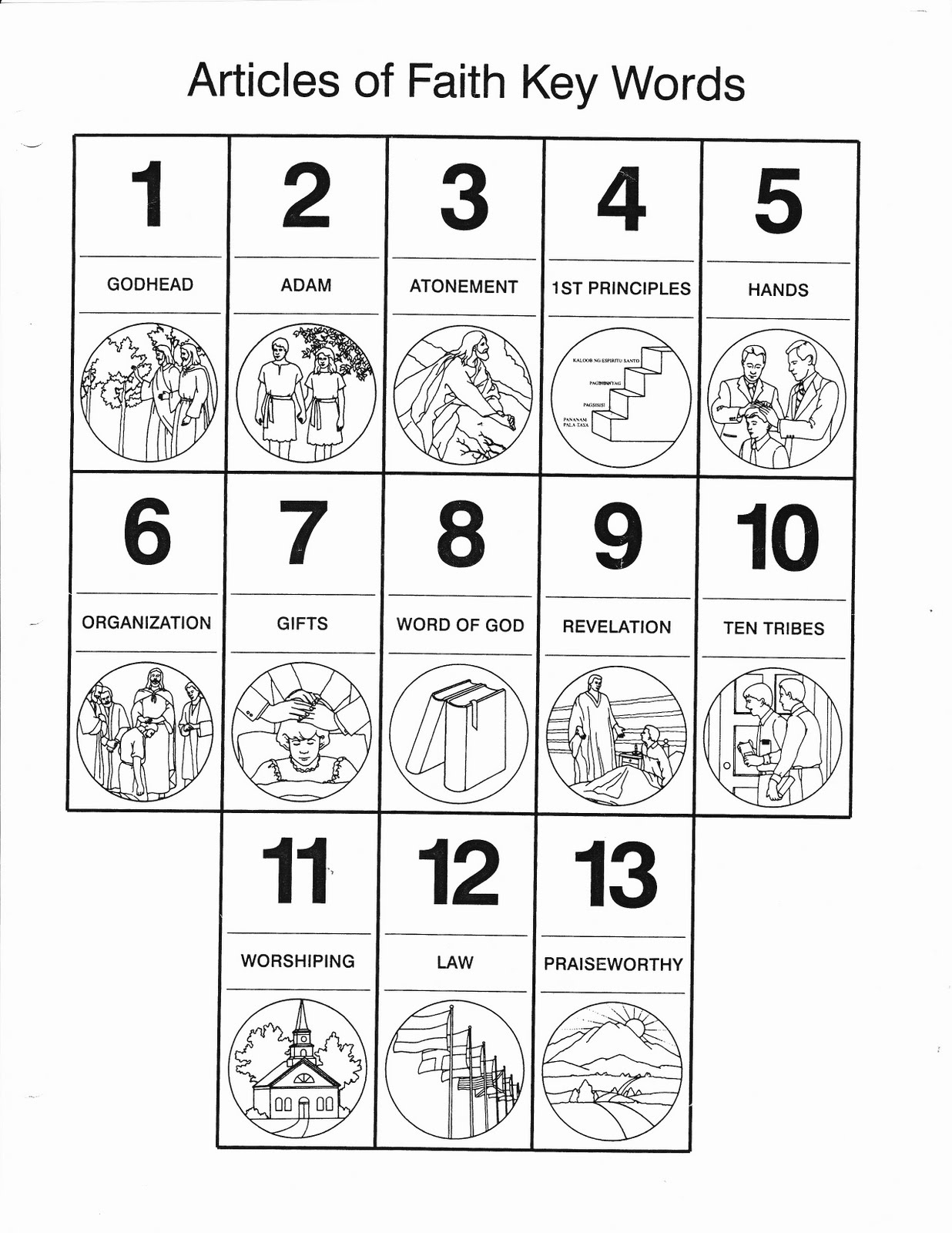
The Friend, June 2011, has an article “All Because a Child Knew the Article of Faith” .  In addition to the message from President Monson there are several resources for memorizing the Articles of Faith.   Included below are those suggestions and others that will help children develop a life-long  testimony builder – knowing the Articles of Faith.
    • Try the online Articles of Faith Memory Quest at lds.org.
    •  Another great resource for memorization techniques is Teaching No Greater Call p 171-172, in “Methods of Teaching” 
    •  Music is also a great facilitator in memorization.  The Article of Faith Songs are included in the playlist below and are available for download from the church Music site.  Find the songs in the alphabetical listing  with the title written beginning with “The [number written out ie. First] Article of Faith”.
    • Key words are mentioned in the article.  The graphic on this post is from key words published in a past issue of The Friend.  Click on the graphic to enlarge.
    • The Friend  in 2011 has been featuring an Article of Faith each month with learning activities.  Check out this month’s “Article of Faith 6". 
    Be an example - make sure you too memorize the Articles of Faith.

    12 April 2011

    Become As a Little Child

    from lds.org
    Sister Jean A. Steven, counselor in the General Primary Presidency, used examples of children living the gospel and their effect on others in her General Conference talk, Become As a Little Child. She followed these examples with this statement, “If we have a heart to learn and a willingness to follow the example of children, their divine attributes can hold a key to unlocking our own spiritual growth”.


    In Primary we have the wonderful opportunity to help direct the faith and willingness of children to DO what the Savior wants, live His commandments. In the 2011 Outline for Sharing Time: Instructions for Sharing Time we are given three steps for gospel instruction; 1) Identify the doctrine, 2) Encourage understanding, and 3) Encourage application. We need to always include step three, “Encourage Application”. Helping the children set a goal and DO the things they are taught will not only bless their lives, but the lives of those who see them. Sister Stevens illustrated this principle through her story of a bishop who helped the entire ward live the law of tithing by first visiting Primary. “He taught the children about the Lord’s law of tithing and asked if they would be willing to pay tithing on the money they earned. The children said they would. And they did.”

    Let us make a commitment to follow the Savior’s entreaty to “. . . Behold your little ones” (3 Nephi 17:21–23). Give them guidance and then follow their faithful example.