Showing posts with label Sharing Time. Show all posts

09 December 2011

Plan Now for Success

by Tiare Fullmer

2012 is fast approaching and if you do some preliminary planning now, you will find things going much more smoothly and successfully in the coming year.

Here are some ideas you might want to consider:

  • Outline / calendar – Look ahead and plan for stake and general conference, CSMP, etc.. Assignments can be made for conducting sharing time, giving gospel instruction, visit classes, greeting, etc...

Here is an example:


Monthly theme and scripture Monthly song Activity/ Lesson
Jan Agency Is the Gift to Choose for Ourselves
“Wherefore, men are free... to choose liberty and eternal life, through the great Mediator of all men” (2 Nephi 2:27)
As a Child of God (outline) 14th - Stake Aux. Training


Weekly theme
Open Ex
Conduct
G Instruct
Visit
Lesson #
1 Introduce 2012 Theme
Talk - Bish
2nd C
1st C

1
8 Agency is the gift to choose for ourselves.
A of F, myGS
Presi
2nd C
1st C
2
15 Agency is the gift to choose for ourselves.
Talk - child
2nd C
1st C
Pres
3
22 In the premortal life, I chose to follow God's plan.
Pres message
Presi
Sec
2nd C
4
29 Jesus Christ created the earth as a place where I can learn to choose the right.
Talk - child
1st C
Pres

5
  • Talks / scriptures / prayers for sharing time -– Figure out the way you will assign and remind the children [and their parents] Keep track so all can have a chance participate and of children and their talks that you might want to include in the CSMP.
  • Sharing Time Agenda - Plan a basic agenda that you can use each week to conduct Sharing Time that has places to fill in the talks, prayers, songs, etc.
  • Goals - Set long term goals to improve your effectiveness at accomplishing the purposes of Primary. This is the step-back, big-picture kind of planning. Periodically evaluate and track your progress. The Primary secretary can be great help here as well.
  • Presidency duties – A list to define who is responsible for what – ex: 1st Counselor - over AD for G and CTR classes and general teacher improvement...
  • Presidency meetings – When and where will you have them? This council is very important to a properly functioning Primary – if you are having lots of difficulty – check and see if this meeting is happening effectively.
  • Lesson schedule – make yearly schedule so all know which lesson they should be on – especially great for when you need last minute substitutes, etc. A list of approved substitutes is another thing you can include for teachers
  • Class lists , teacher instructions and next year manuals [CTR and Valiant classes all change manuals]– Plan how you will get this information to the teachers. Remember, personal contact is always best so you can encourage, answer any ?? and determine what there needs are.
  • Parent letter – Introduce parents to the yearly theme and give them any instructions such as picking up children promptly, making sure children go to the bathroom before coming to Primary, not allow children to bring toys, policy about food, etc...
  • Nursery schedule– The basic Sunday schedule, possibly who does what each week, snacks...
  • Nursery parent letter – Again, involve the parents and make sure they know the policies, etc.
  • Music plan – The outline has basic songs to teach listed under several months, but gives plenty of room for you to chose songs. If you have a plan of specific songs you want to teach and make sure the children know well this year, it will focus your singing time. You can also have a plan for opening exercises songs. If this is planned and given ahead of time to the presidency, they have time to make sure it's correct on the agenda and opening exercises will flow smoothly.
  • Music practice CD – audio files of all the Primary songs are available on the church website. Making a Cd for each child of the songs you will learn and emphasize this year can really be helpful, especially to children who don't attend consistently.
  • AD for girls & cub scouts and 11 yr scouts – Expect the leaders of these groups to plan ahead and have a basic calendar for the Presidency to approve. The scouts should each have a rotating calendar to make sure all requirements can be met during the year. [Get LDS scout training if you don't understand this!]

Get your lists and schedules set up ahead, and make sure all who need it have a copy. Then you just simply execute the plan each week. Remember, you can tweak if needed, but the basics are in place. Many of these lists and schedules are great to post on the inside of your closet door, etc. Remember to plan with prayer and purpose. You will have greater success when you plan ahead and are prepared at the beginning of the year. Then, you will have much more time for the real work of Primary – people!

If you want it to happen – plan for it!

06 June 2011

Memorizing the Articles of Faith

The Friend, June 2011, has an article “All Because a Child Knew the Article of Faith” .  In addition to the message from President Monson there are several resources for memorizing the Articles of Faith.   Included below are those suggestions and others that will help children develop a life-long  testimony builder – knowing the Articles of Faith.
    • Try the online Articles of Faith Memory Quest at lds.org.
    •  Another great resource for memorization techniques is Teaching No Greater Call p 171-172, in “Methods of Teaching” 
    •  Music is also a great facilitator in memorization.  The Article of Faith Songs are included in the playlist below and are available for download from the church Music site.  Find the songs in the alphabetical listing  with the title written beginning with “The [number written out ie. First] Article of Faith”.
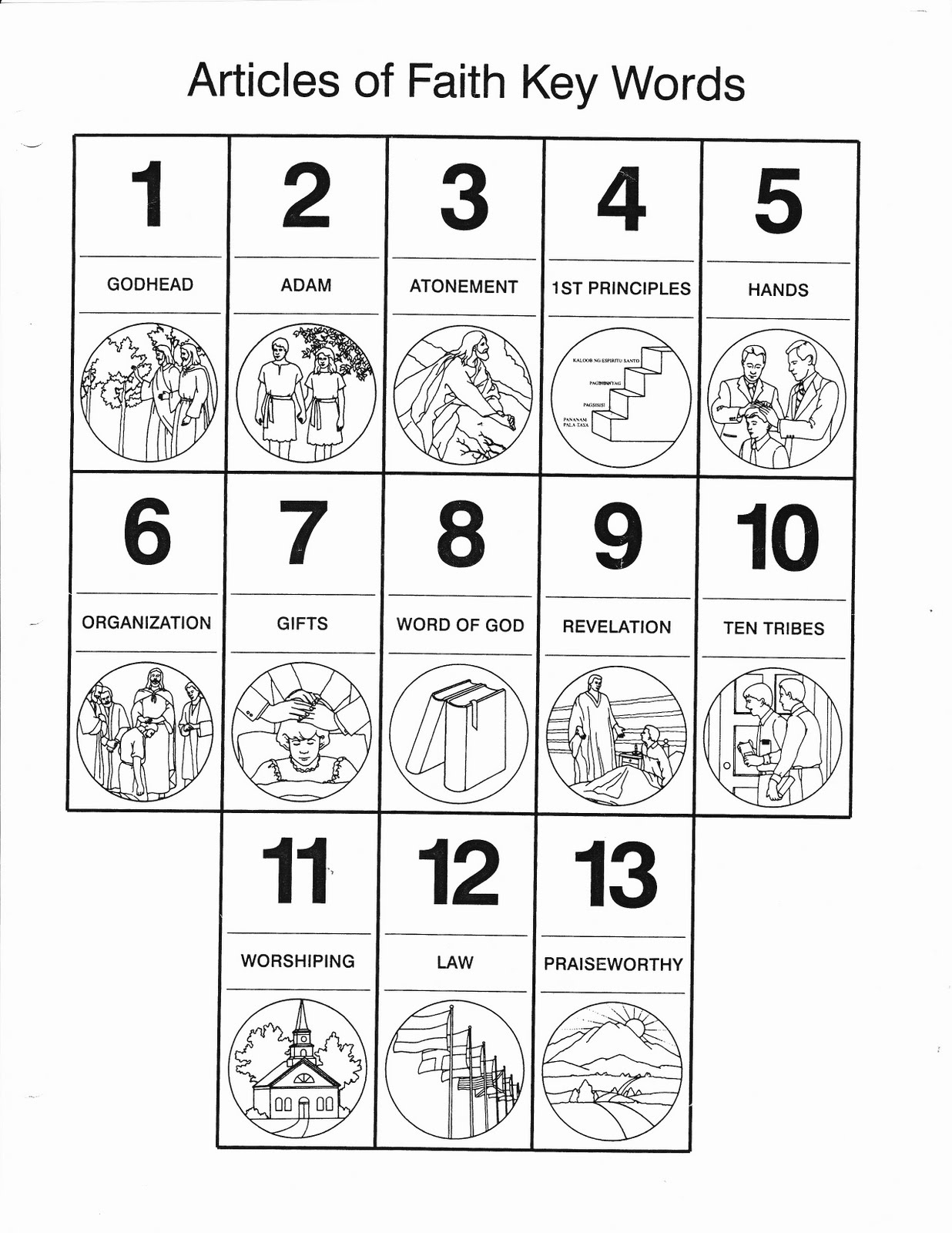
    • Key words are mentioned in the article.  The graphic on this post is from key words published in a past issue of The Friend.  Click on the graphic to enlarge.
    • The Friend  in 2011 has been featuring an Article of Faith each month with learning activities.  Check out this month’s “Article of Faith 6". 
    Be an example - make sure you too memorize the Articles of Faith.

    12 April 2011

    Become As a Little Child

    from lds.org
    Sister Jean A. Steven, counselor in the General Primary Presidency, used examples of children living the gospel and their effect on others in her General Conference talk, Become As a Little Child. She followed these examples with this statement, “If we have a heart to learn and a willingness to follow the example of children, their divine attributes can hold a key to unlocking our own spiritual growth”.


    In Primary we have the wonderful opportunity to help direct the faith and willingness of children to DO what the Savior wants, live His commandments. In the 2011 Outline for Sharing Time: Instructions for Sharing Time we are given three steps for gospel instruction; 1) Identify the doctrine, 2) Encourage understanding, and 3) Encourage application. We need to always include step three, “Encourage Application”. Helping the children set a goal and DO the things they are taught will not only bless their lives, but the lives of those who see them. Sister Stevens illustrated this principle through her story of a bishop who helped the entire ward live the law of tithing by first visiting Primary. “He taught the children about the Lord’s law of tithing and asked if they would be willing to pay tithing on the money they earned. The children said they would. And they did.”

    Let us make a commitment to follow the Savior’s entreaty to “. . . Behold your little ones” (3 Nephi 17:21–23). Give them guidance and then follow their faithful example.

    20 December 2010

    Help from the Friend - January 2011

    Check out the “What’s online this month?” on the back cover.  Depending on your electronic interests, there are several options that might want to try such as mobile applications, Facebook and Twitter.

    Primary 7: New Testament
         Lesson 5: The Childhood of Jesus Christ – “Jesus as a Child”, p 6-7

    Sharing Time – Gospel Instruction
         January – “Bringing Primary Home:  The Scriptures Are the Word of God”, p 40-4
              “Coloring Page:  The scriptures are the word of God” p 46 
         September – “Where Is Isabelle?” p 8-9

    Sharing Time – Music Time
         “If I listen With My Heart”, p 24-25

    Sharing Time – Opening
         “Sammy’s Scriptures”, p 36

    Activity Days for Girls
         “Bulletin Board:  Time Capsule”, p 12
         “Bulletin Board:  Understanding the Scriptures”, p 13
         “Bulletin Board:  Run, Jump, Play!” p 13
         "Little Women from Massachusetts”, p 18-19

    Activity Days for all Children (just a note – these activities are not mentioned in the new handbook, but the guidelines are contained the Faith in God guidebooks, p 18)
         “Friends in the News:  Barrigada Branch”, p 47

    Faith in God
         Serving Others - “Going the Extra Mile”, 20-21
         Articles of Faith – “Article of Faith 1”, p 22 
              (also note online – “Play Articles of Faith Memory Quest at friend.lds.org!” 
         My Gospel Standards “Listen for His Voice”, p 2-3 “The Cookie Solution”, p 4-5
         Learning and Living the Gospel – “Guide to the Friend:  Possible Ideas for Family Home Evening, #1”, p 48

    Pre-opening activity for Cub Scouts, Patrol of 11-year-old Scouts, Activity Days for Girls
         “Funstuf: Say What?” p 43

    Cub Scouts – “Friends by Mail:  How the Friend Helped Me”, inside front cover


    26 August 2010

    Tell Me the Stories of Jesus

    In the April 2010 General Conference, Elder Neil L. Andersen spoke of the importance of children hearing the stories of Jesus to build their personal testimonies. (Tell Me the Stories of Jesus)  He said:

    “The stories of Jesus can be like a rushing wind across the embers of faith in the hearts of our children. Jesus said, “I am the way, the truth, and the life.”  The stories of Jesus shared over and over bring faith in the Lord Jesus Christ and strength to the foundation of testimony. Can you think of a more valuable gift for our children?

    Are the life and teachings of Jesus Christ embedded in the minds and souls of our children? Do they think about the Savior’s life when they wonder what to do in their own lives? This will be more and more important in the years ahead”.

    He included this promise:

    “As you reverently speak about the Savior . . . the Spirit of the Lord will accompany your words.
    As you do your best, the testimony of Jesus will gently distill upon your children’s hearts. They will go to their Heavenly Father in humble prayer and feel His influence through the power of the Holy Ghost. A stronger personal faith in Jesus Christ will prepare them for the challenges they will most surely face”.

    We have the opportunity to share the stories of Jesus in every aspect of Primary; nursery, Sunday classes, sharing time, music, closing exercises, Activity Days for Girls, Cub Scouts, patrol of 11-year-old Boy Scouts, and Activity Days for All Children.  As we faithfully endeavor to bear witness of the Savior by telling the children stories about Him, they will be strengthened for a lifetime.


    25 June 2010

    Help from the Friend - July 2010

    The following are examples of how this month’s Friend can be used in Primary:

    Activity Days for Girls, Scouting
                    “Funstuf”, p 17
                    “A Quilt that Tells a Story”, p 24-25
                    “Friends in the News: Westchester First Ward”, p 47
                    “Possible Ideas for Family Home Evening”, p 48
    Faith in God, My Gospel Standards
                    “Courage”, p 16
                    “He Told Me, No Way”, p 28-29
    Example of Application of July Sharing Time Theme
                    “Trying to Be Like Jesus”, p 30-31
    Primary 1: I Am a Child of God, lesson 5 and 6
                    “For Little Friends: Who is Jesus?”, p 32-33
    Behold Your Little Ones, lesson 8
                    “Brigham’s Right-Way Feet”, p 35
    Primary 6: Old Testament, lesson 28
                    “Coloring Page: David and Goliath”, p 46

    20 May 2010

    Using the Scriptures in Primary - "Look For"

    A teaching tip on the June page of the 2010 Outline for Sharing Time, p 12, states, "It is important for children to learn gospel truths from the scriptures. Help the children focus and listen when scriptures are read.
    Even young children can listen for a specific word or two as you read a verse".  More information on this teaching technique can be found in Teaching No Greater Call, p 55.  The section is "Teaching From the Scriptures: Use "Look for" and "Listen for" Approaches".  Having children focused on a specific idea as a scripture is read involves both the reader and the listener.  Before a scripture is read, ask the children to "Look for" or "Listen for" an answer to a question.  Younger children may be directed to listen for factual details while older children can look for conceptual or application connections.  

    This "Look for" method of teaching from the scriptures can be used throughout Primary; during classes, sharing time gospel instruction, and sharing time music.  Engaging the students in the scriptures by asking "Look for" and "Listen for" questions will not only improve learning, but also teach children a life-long skill of looking for answers as they read the scriptures.  

    One more scripture use tip:  Children, and many adults, have difficulty finding a scripture when only given the standard reference such as Deuteronomy 6:6-7.  Give enough information to make finding the scripture easy, especially the page number.  Example giving specific information and waiting until everyone is ready before the next direction is given:  
    • Let's get the Bible and look in the Old Testament.  That is in the first part of the book. 
    • Now let's look in Deuteronomy, chapter 6.  That is on page 263.  
    • While you read verse 6 look for what should be in your heart.  . . .(discuss answer) 
    • Now, turn the page and read verse 7 looking for who we should share this with. (Just in case you want to do it even easier while you are reading this post go to http://scriptures.lds.org/en/deut/6).  
    With four standard works containing 87 books plus sections, chapters, declarations, introductions, title pages, study helps, etc. it is no wonder we feel fear when we hear the words, "Let's turn in the scriptures to . . . . ."

    "Inviting children to learn from the scriptures will help them develop a lifelong love for the word of God.  Plan ways each week to invite the children to use and learn from their scriptures"  2010 Outline for Sharing Time, Introduction.


    01 February 2010

    Help from the Friend - February 2010


    The following are a few ideas of how this month's Friend can be used in Primary:

    Activity Days for Girls and Scouting
        "A Banner of Faithfulness" p 2-3
        "Bulletin Board" p 12
        "Funstuff: Seeking Service", p 26
        "Cease From Anger", p 28 - relate to My Gospel Standards

    Lesson Supplement - "Heavenly Father and Jehovah Created the World", p 14-15
        Behold Your Little Ones, Lesson 7
        Primary 1: I Am a Child of God, Lessons 8-14
        Primary 6: The Old Testament, Lesson 3

    Lesson Supplement - "For Little Friends: Tithing the Best Choice", p 32-35 - especially helpful for adapting lesson for younger children on tithing.
        Primary 2: Choose the Right A, Lesson 33

    Cub Scouts
        "The Best", p 20-21 (relate to the Cub Scout motto, "Do Your Best")

    Activity Days for all Children
        "Secret Servers to the Rescue", p 22

    "Sharing Time: Jesus Christ Is My Savior and Redeemer"
    Remember that this resource is for the children to use on their own or in an Activity Day NOT during Sharing Time on Sunday. Follow the lessons provided in 2010 Outline for Sharing Time: I Know My Savior Lives for the Gospel Instruction portion of Sharing Time.

    31 December 2009

    Help from The Friend – January 2010


    This month's Friend is packed with ideas for leaders and teachers in the Primary.
    Here are a few:
    1. The "Sharing Time" page (p 40-41) no longer provides teaching ideas for Sunday Sharing Time. See the following note from FAQ on lds.org/pa:

      "Will sharing time ideas still be in the Friend magazine?
      Starting with the January 2010 issue of the Friend magazine, the sharing time ideas for leaders will no longer be included. These ideas are incorporated into the outline for sharing time. The sharing time for children will still be in the magazine". http://www.lds.org/pa/display/0,17884,7701-1,00.html

      One possible way of using the "Sharing Time" pages this year could be in Activity Days for Girls and Scouting. Completing the Scripture Journal suggested for this year could be a great goal for Faith in God. This month focuses specifically on the first Article of Faith and its meaning.

    2. "I Know that My Savior Loves Me", p 24-25 – Includes a teaching suggestion for Primary music leaders.

    3. Primary is a time to prepare children to receive their first temple recommend. They will have the opportunity to do baptisms for the dead at age twelve. "A Year on Temple Square: The Salt Lake Temple", p 6-7 gives information about temples and provides a link to an online video that will show what it is like to go inside the temple to be baptized for the dead.

    4. The Friend Magazine Resource page http://www.lds.org/pa/display/0,17884,8879-1,00.html is an index of "activities, songs, and stories . . . collected from the Friend magazine and arranged by topic. This resource can be used by Primary leaders, teachers, and parents as they plan sharing time, class lessons, and family home evening".

    02 December 2009

    2010 Outline for Sharing Time and Changes in Sharing Time


    2010 Outline for Sharing Time

    Here are answers to frequently asked questions regarding this outline. (Frequently Asked Questions http://www.lds.org/pa/display/0,17884,7701-1,00.html)
    • What do we do for sharing time for the fifth Sunday of the month?
      "When there is a fifth Sunday, use this time to review previous lessons" (2010 Outline for Sharing Time, inside front cover).
    • Do we still do class presentations during sharing time?
      Starting January 2010, there will be no class presentations. However, "occasionally you [the Primary presidency] may invite teachers and their classes to help you with parts of the gospel instruction" (2010 Outline for Sharing Time, inside front cover).
    • How should we divide up sharing time and singing time?
      Fifteen minutes should be for gospel teaching and twenty minutes for teaching music (see 2010 Outline for Sharing Time, 1).
    • Can we use pictures in the sacrament meeting presentation?
      "Visuals, costumes, and media presentations are not appropriate for sacrament meeting" (2010 Outline for Sharing Time, 1).
    • Have class names been changed?
      The Primary class names have been aligned with the ages of the children on January 1. For example, the CTR 4 class is for children age four on January 1, the Valiant 8 class is for children age eight on January 1, and so forth (see 2010 Outline for Sharing Time, 1).
    • Will sharing time ideas still be in the Friend magazine?
      Starting with the January 2010 issue of the Friend magazine, the sharing time ideas for leaders will no longer be included. These ideas are incorporated into the outline for sharing time. The sharing time for children will still be in the magazine.

    23 November 2009

    Children’s Sacrament Meeting Presentations


    A CTR 5 runs to his parents in the congregation and announces, "I did it!"; an eleven-year-old boy quotes from memory James 1:5 and tell of Joseph Smith's search for answers; and a Sunbeam makes a fist and raises it into the air with a triumphant "yes". These are some of the familiar scenes from the annual Children's Sacrament Meeting Presentation. Personal growth and spiritual understanding are realized through a year's experiences in Primary focused on one meaningful gospel theme. The music that they have learned will be remembered throughout a lifetime. They will sing the songs to their own children and the words will come into their minds when important decisions are made. What an awesome tool for spiritual preparedness.

    For most of you, this year's presentation is completed and now it is time to begin preparing for next year. I have emphasized several things you need to start in the beginning of 2010.

    The following information is in the 2010 Outline for Sharing Time: I Know My Savior Lives, p 1.
    1. The Sacrament Meeting Presentation is under the direction of the bishop or branch president.
    2. Meet with the counselor in the bishopric or branch presidency who oversees Primary early in the year to discuss preliminary plans.
    3. Obtain approval when the plans are completed.
    4. Plan for the presentation to be based on the monthly sharing time themes.
    5. Keep notes throughout the year of children's talks and personal experiences for possible use in the presentation.
    6. Think of ways to help the congregation focus on the gospel doctrines the children are teaching.
    7. As you prepare the presentation, remember the following guidelines:
      • Practices should not take time away from classes or families unnecessarily.
        • Visuals, costumes, and media presentations are not appropriate for sacrament meeting.
        1. It is not necessary to give each child a scripted speaking part.
        2. Effective presentations involve the children in a variety of ways.

        18 October 2009

        How to Teach a Song


        http://www.lds.org/pa/primary/pdf/PRI_2009_HowToTeachASong_eng.pdf


        Know the song: Before you can teach a song effectively, you must know the song yourself. Become familiar with the words and melody by playing the song on the piano, listening to a recording of the Children's Songbook, or listening to the music on the internet (lds.org church music web site)


        Sing the Song: Children learn to sing a song by hearing it sung and by singing it themselves.


        Use the scriptures: Study the song to learn what message the words convey. How could you use the scripture references at the end of the song in your preparation or in teaching the song.


        Capture the children's attention: Capture the children's attention with an object, a picture, a scripture, an experience, or simply a whisper.


        Direct children's listening: Ask questions that will encourage children to listen to the song and help children understand the gospel message…for example, What? Where? When? Why?…and state the question in such a way children can discover the answer as you sing the song.


        Involve the children: Have children improvise actions. Assign small groups to sing different sections or verses.


        Sing, sing, sing: Have children hum or sing the prelude music. For special occasions have a child sing a solo or ask a group of children to sing a chorus. Have the children sing a song that teaches the gospel principle being taught in a sharing time.


        Bear testimony: Bear your personal testimony, or read testimonies recorded in the scriptures. As children hear the testimonies of others they will be strengthened.


        18 September 2009

        Play Dough Play


        Children in nursery enjoy play dough.  There are several things to remember to keep this activity fun for the children, the teacher, and the carpet.


        1. Place a plastic tablecloth (or someting similar) under the table and chairs.
        2. Provide toys, such as cookie cutters and rolling pins, to be used exclusively with play dough.
        3. Don’t allow other toys to be used at the “play dough table”.
        4. Be sure that the children only use the play dough while seated at the “play dough table”.
        5. Make your own play dough using the following recipe or another one that is similar.  Keep the entire batch the same color.  This eliminates the impossible task of trying to keep colors from being mixed or the discussion about who gets which color.
        6. Put away the play dough, play dough toys, and plastic after Play Time.  It is most successful to have play dough available only once during nursery, so decided which time is best for the children.
        7. If the play dough gets dropped, pick It up immediately.  It has a tendency to travel into the carpet on the bottom of shoes.
        8. When play dough time is over, check for any spots on the carpet and brush away before the play dough hardens.

        Play Dough (similar to commercially available Play-Doh)
        This recipe makes a soft dough that can be brightly colored.  It is edible, although it tastes terrible.


        1 cup flour
        1 tablespoon salad oil
        1 cup water
        ½ cup salt
        2 teaspoons cream of tartar

        Food coloring (1/8 - 1/4 teaspoon paste type coloring, unsweetened drink mix (Kool-Aid) or liquid food coloring)


        Combine flour, oil, water, salt, and cream of tartar in a large saucepan.  Using a wooden spoon, stir over medium heat.  Stir constantly to prevent sticking.  The mix will be soupy and then suddenly stick together and can be stirred into a ball.  When it thickens, remove from the heat and continue stirring.  Turn hot ball out onto a floured surface.  When it is cool enough to handle, kneading until it is smooth and silky (a silicone mat can be used and no additional flour is needed). 

        Add desired food coloring by kneading, adding more until the desired color is achieved.  To avoid staining your hands with the concentrated color you can wear gloves or use plastic wrap.  When the color is distributed the color won’t stain your hands.

        Note:  If you plan on coloring the entire batch the same color, the food coloring can be added before the mixture is cooked.

        Keep in an airtight container or Ziploc bag.


        Other uses of play dough:
        • With supervision, this play dough could be made by the girls during Activity Days.  It could be used as a service project for the nursery or made for gift giving.
        • The dough could be used during Activity Days or teaching situations (sharing time or classes) for the children to make visual items to correlate with the lesson.

        08 September 2009

        Sharing Time and the Children’s Sacrament Meeting Presentation

        Summary of Auxiliary Training:  Use the Outline for Sharing Time booklet to teach the 15 minute lesson each week during sharing time.  Supplement these weekly lessons, as needed, by Church-approved materials. 

        LOVE those you teach; teach by the SPIRIT; and invite DILIGENT learning by doing all of these things in every lesson:
        • Identifying  the doctrine
        • Encouraging understanding
        • Encourage application

        We noted the changes in sharing time:
        1. It was a 30 minute period, now 15 minutes is designated for the lesson and 20 minutes for music. (Music can still be a part of the lesson too).
        2. There were class presentations once a month, now there are no monthly class presentations, but you may occasionally invite teachers and their classes to help you with parts of the gospel instruction.
        3. Fifth Sunday lessons will be a time to review previous lessons.
        4. Although not a change, remember when inviting guest speakers to participate in Primary, you should get the approval of your bishop or branch president before making the invitation.
        We looked through the new 2010 Outline for Sharing Time with excitement over the changes in format.  There are complete lessons, and some ideas for us to develop.  There are teaching tips all through the booklet and pictures to show what an activity will look like.  The images, and word strips will be available on-line.  Remember to use The Friend and other approved materials listed on the side as we develop some ideas.  We tried a few ideas from the music sections in the new booklet and took home buttons on strings to use with our units (see 2010 Outline for Sharing Time, page 15).
        We talked about the Sacrament Meeting Presentation and went over how it should be developed throughout the year. We emphasized that it is under the direction of the Bishop or Branch President and that we should meet with the counselor who oversees primary early in the year to discuss preliminary plans.  We obtain approval when plans are completed.  Practices should not take time away from classes or families unnecessarily and visuals, costumes, and media presentations are not appropriate for sacrament meeting. 
        We are all looking forward to the new and excited about finishing up what we have been doing this year.  The church has provided us with a wonderful resource to teach His children. Now we must dedicate ourselves to provide these beautiful lessons, prepare well and teach with the spirit. 
        - Jackie Bowen